
Last updated:
Start with the declarations page, not the storm size
Hail and wind are standard perils on most HO-3 homeowners policies, but your policy decides what is covered. Check your declarations page for the policy period, dwelling limit, deductible and any roof-related endorsements. Then read the relevant policy terms or ask your insurer to explain them. A general statement about homeowners insurance is not a coverage decision for your home.
A damaging storm and a covered loss are related but different questions. An inspection can document roofing condition; your insurer applies the contract to that evidence. Wear, deterioration and damage that predates the event may be treated differently from sudden hail impacts. Keep those distinctions in mind before assuming a roof replacement will be paid for.
Three terms that change what you are paid
Your deductible: flat or wind/hail percentage
A deductible is your share of a covered loss. Some policies use a flat deductible; others have a separate wind/hail percentage deductible, a common arrangement in Missouri and Illinois. That percentage can be based on the insured dwelling amount rather than the contractor's repair bill. Check your declarations page instead of guessing what the percentage applies to.
Ask which deductible applies to the event and whether roof-specific terms also apply. A covered repair can still leave no insurance payment if its covered amount falls below your deductible. That does not mean the roof needs no attention; it means coverage and the amount payable are different questions.
Replacement cost versus actual cash value
Replacement-cost terms generally address the cost of replacing covered damaged property, subject to the policy's conditions. Actual cash value generally accounts for depreciation. A policy may also release some payment only after work is completed and documented. Ask your insurer which settlement basis applies specifically to the roof rather than assuming the entire home has identical terms.
Roof-age schedules
Some policies use a roof-age schedule that changes the portion payable as the roof gets older. Age may affect settlement even when hail itself is covered. Check your declarations page and roof endorsements, and ask how the insurer established the roof's age. Installation records can help clarify that fact, but they do not override the policy.
How an adjuster evaluates replacement versus repair
Adjusters may inspect representative test squares on roof slopes and record observed impacts or hits. This is a way to sample and document conditions, not a universal replacement formula. The type of impact, the material, the distribution of functional damage and the roof's condition all matter alongside the count.
“How much hail damage is enough?” is better understood as a question about functional damage density per slope. A few marks on one area do not automatically justify replacing every slope, and widespread functional damage can lead to a different assessment. The adjuster decides the covered scope under the policy; no contractor can promise a number of hits that guarantees replacement.
For identification rather than coverage, see our guide to what hail damage looks like. Appearance alone cannot tell you how your insurer will settle a claim.
Why metal-roof claims can be different
Hail usually dents metal panels rather than puncturing them. Many policies treat appearance-only dents as cosmetic, and some include specific cosmetic-damage exclusions. That makes metal-roof claims more likely to result in a denial or partial scope when the panels still perform their protective function, rather than an automatic replacement because dents are visible.
Functional damage needs a separate assessment. Disturbed seams, fasteners or other water-shedding details can matter even when a panel has no hole. Ask the inspector to distinguish what affects performance from what changes appearance, then ask your insurer how the relevant policy terms apply. Do not assume that either every dent is covered or no metal-roof damage can be covered.
A short record to make after the storm
- Photograph what you can safely see. Stay on the ground and record exterior clues and indoor water stains.
- Write down the storm date. Keep your observations separate from information reported elsewhere.
- Save a nearby storm report. It provides weather context, not proof of damage to your particular roof.
- If water is coming in, arrange tarping. Keep records of protective work and follow your insurer's instructions.
- Do not sign anything on the doorstep. Take time to read it and understand who you are authorizing to do what.
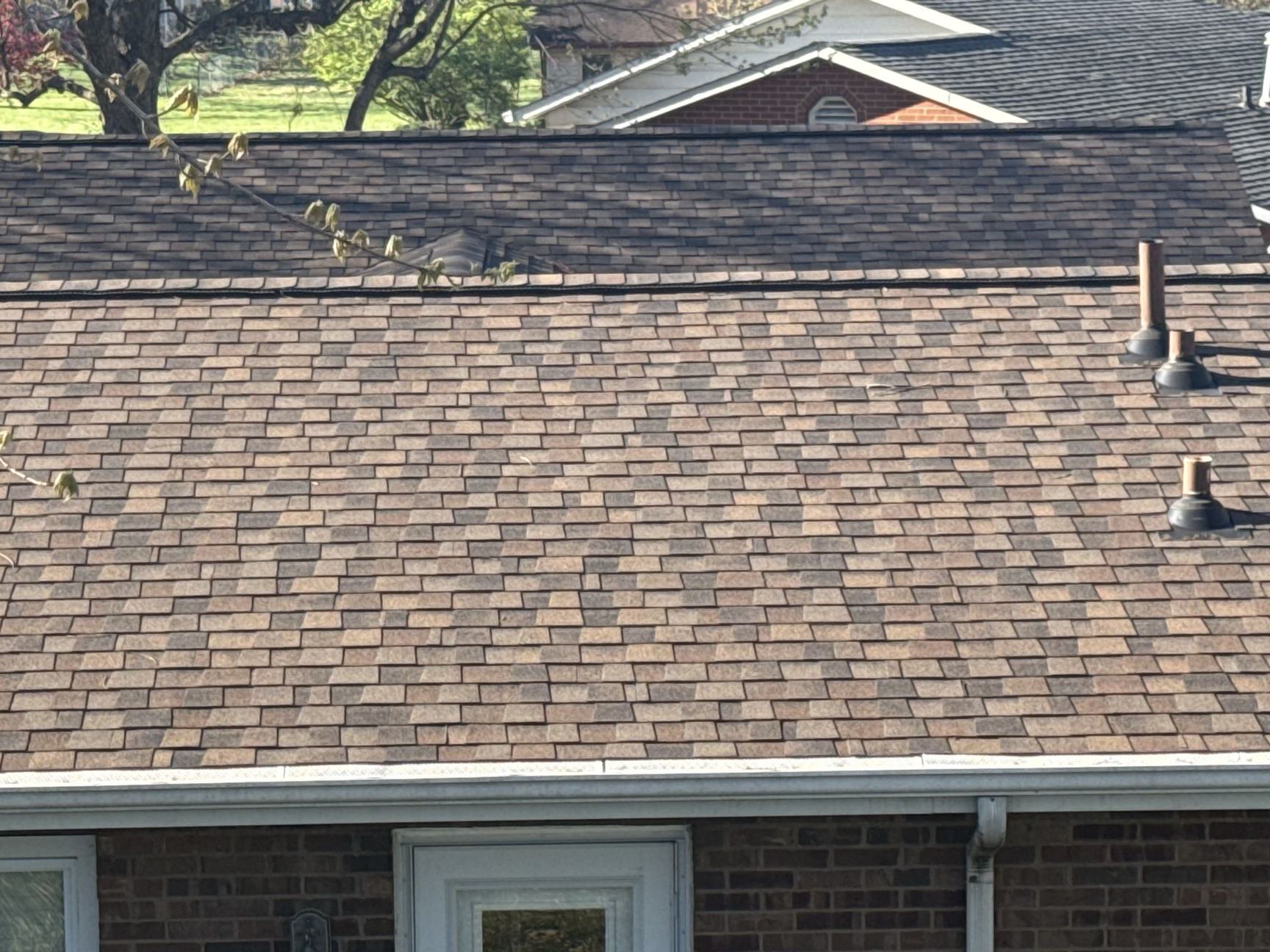
- Get an inspection. Use a photo report to understand the roofing condition before making assumptions about a claim.
This is a documentation checklist, not a replacement for the insurer's claim instructions. Our Illinois insurance and roof replacement guide explains the claim timeline and policyholder detail; Missouri rules differ.
What local storm reports can and cannot prove
National Weather Service storm reports recorded 2-inch hail around Granite City and Troy on May 26, 2024, along with 2.5 to 2.75-inch hail in St. Charles and 81 mph wind near Millstadt. On March 14, 2025, twelve tornadoes crossed the region, including an EF2 through Arnold, Missouri.
Those records can help place your observations in context, but a town-level report does not show what struck your roof. Keep the source with your photos and notes. Do not treat a report of severe weather as a promise of approval, and do not treat the absence of a report at your exact address as a roofing diagnosis.
Notice deadlines: act promptly, check your policy
Most policies require prompt notice after you discover damage. A reporting window is typically within a year, but sooner is better; check your policy rather than treating that general description as a deadline. Requirements for notice, documentation and later steps can differ in Illinois and Missouri and between policies.
What we do, and what we do not do
We provide a free inspection with a photo report and can meet the adjuster on site if asked; we help with the insurance claim process but do not negotiate or adjust claims. Your insurer decides coverage, and our storm damage roofing page covers the roofing work rather than policy interpretation.
Related guides
What to do next
Hail Mary Roofing & Exteriors is based in Glen Carbon, Illinois, serving the Metro East and St. Louis area. Request a free roof inspection with a photo report to understand your roof's condition. Call (618) 806-9898; if water is coming in, we offer 24/7 emergency tarping.
Limited Lifetime Craftsmanship Warranty on asphalt shingle roofs, transferable to a new owner one time; 10-year craftsmanship warranty on all other work.